Showing posts with label Canada. Show all posts

Monday, June 27, 2011

Early Voices: Portraits of Canada by Women Writers, 1639-1914


Light, Bright, and Sparkling has never been a book blog, as my day job is so close to book blogging that writing book reviews after my week's work is done is far too close to a Busman's (or Bookman's) Holiday.  But it's hard to resist telling about any especially interesting book I read, and I'm inspired by this wonderful new book from Canada, Early Voices: Portraits of Canada by Women Writers, 1639-1914 (Dundurn Press) edited by Mary Alice Downie and Barbara Robertson, with Elizabeth Jane Errington.
 
 Baroness von Riedesel and her children


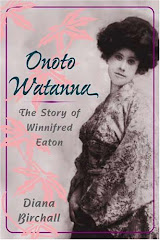
Having an interest in pioneers and frontier life, in the beauty and history of Canada, and in women's lives, for me this book came together as nothing less than a brilliant evocation and illustration of all three. There are of course many anthologies of women writers, Canadian and others, but what makes this one so satisfactory is the exceptionally judicious, felicitous, happy selection. Not growing up or being educated in Canada, one learns shamefully little about Canadian history or literature in school, and I only developed an interest because my grandmother and great-aunt both happened to be pioneering Canadian women authors. My grandmother, Winnifred Eaton (1875-1954) was the first Asian American woman novelist, though she took on a fake Japanese identity and pen name (Onoto Watanna) to write her romantic novels with Japanese settings and titles such as The Heart of Hyacinth and The Wooing of Wisteria. She also wrote two memoir style novels of her early life in Montreal, Me (1915, republished by U. of Mississippi Press) and Marion (1916, reprint forthcoming from U of McGill Press), and two novels of Calgary prairie life in the period between the two world wars, Cattle and His Royal Nibs. Her career was flamboyant and fascinating, and the greatest professional joy of my life was researching and learning about her, and publishing my biography Onoto Watanna (U of Illinois Press, 2001). But even my partisan delight in my fabulous granny cannot blind me to the fact that her older sister, Edith Eaton, is generally seen as the more noble character and arguably finer writer. Both sisters were among the fourteen children of an Englishman and his Chinese wife, and sensitive, idealistic Edith was very sympathetic to her mother's plight as a scorned ethnic minority. Both sisters suffered from prejudice as being "half-caste," but where "Winnie" took the veiled method of creating some sympathetic Asian heroines, Edith fought for justice and equality for the Chinese community in her writing, her journalism, and her social work. Writing under a Chinese pen name, Sui Sin Far, she is now called "the spiritual foremother of contemporary Eurasian authors."

Sui Sin Far, my great-aunt

What ancestors for a nice Jewish girl to have, and I am inordinately proud of them! It was Sui Sin Far's inclusion in this collection that led me to it, but that's not the only, or even the main reason for my very great enjoyment of the book.  For that matter, the book is rather cavalier about my grandmother ("We regard the discovery of half-Chinese Sui Sin Far, also known as Edith Maude Eaton, as a triumph. The novelist and journalist, Onoto Watanna, looked promising, until we discovered that she was Sui Sin Far's sister Winnifred, masquerading as an exotic half-Japanese"). No, it is because it serves an introductory purpose better than I have ever seen any related anthology do. As a non-Canadian, I had heard of a few of these women authors, and had even read the books of arguably the most famous, Catherine Parr Traill. I wanted to know more of these remarkable early-Canadian stories, but most selections give you only a thumbnail, so you're left not really "knowing" the author.  Or else they give you dull excerpts, so you don't want to know more about the author! Not so here. Each of these excerpts is vital and alive, intensely vivid journalistic prose, that has a "you are there" effect of putting you in the picture. You start reading and the modern world disappears, and you're back in 19th century Canada, with refined and educated women who have been put down almost in the middle of nowhere, and who respond in a variety of fascinating ways. You could seek out and read the full versions of these women's writings, and I have no doubt that I will, but this book also feels quite complete in itself.  The selections are so inspired that the reader becomes absolutely rapt in the stories, and when you lift up your head and close the book, you find that you really have learned a great deal! To paraphrase Mr. Eliott in Persuasion on his idea of good company, "that is not a good book, that is the best."

Anna Brownell Jameson

And who are these women? They are nothing if not diverse. The editors have not chosen a group who all sound the same, a collection of Catherine Parr Traill clones, but women of different backgrounds who had very different experiences in early Canada.  Elizabeth Jane Errington writes, "We still tend to see New France, British North America, and 19th century Canada as worlds inhabited by strong men and silent women." Nothing could be farther from the case than this eclectic collection, in which we find such voices of vitality.

There's Mary Barbara Fisher (1749 - 1841) whose husband fought in the American Revolution, and as Loyalists they fled to Nova Scotia. A manuscript by her daughter details the settlers' first cruel winter and shows a certain anti-American animosity, for she writes, "There were no domestic animals in our settlement at first except one black and white cat, which was a great pet. Some wicked fellows, who came from the States, killed, roasted and ate the cat, to our great indignation." This depredation seems less horrific when you read the account of how stunningly little the settlers had to eat!

I liked the description by Baroness von Riedesel (1746-1808), wife of the general in command of the Hessian troops, of an 18th century freezer:

"At the beginning of November people lay in their winter provisions. I was very surprised when people asked me how much fowl, and particularly how many fish I wanted and where I should like to have the latter left, since I had no pond. In the attic, I was told, where they would keep better than in the cellars. Accordingly I took three to four hundred, which kept very well through the winter. All that had to be done when a person wanted meat, fish, eggs, apples, and lemons for the midday meal was to put them in cold water the day before. Thus the frost is thoroughly removed, and such meat or fish is just as juicy, even more tender than that we have at home. In addition to this, poultry is packed in snow, which forms such a crust of ice that one must chop away with a hatchet."

A little later the Baroness tells a story of some Indians who kept coming to a settler named Johnson saying they dreamed he gave them rum and tobacco. He gave them all they wanted, but one day went to them and said he dreamed they gave him a certain large piece of land. They held council and told him, "Brother Johnson, we give you the piece of land, but dream no more."
Baroness von Riedesel

Anna Brownell Jameson (1794-1860) the Irish-born wife of the Attorney General of Upper Canada, left him and returned to England where she became a critic and champion of women's rights, but her Winter Studies and Summer Rambles (1838) seems to be a charming account, in which she tells of a tempestuous, wet night spent on a rock in Lake Huron. Later, reaching an inn in Toronto, she rejoiced in a luxurious little bedroom with white curtains, but adds, "but nine nights passed in the open air, or on rocks, and on boards, had spoiled me for the comforts of civilization, and to sleep on a bed was impossible: I was smothered, I was suffocated, and altogether wretched and fevered; I sighed for my rock on Lake Huron."

Indian lodges sketched by Anna Jameson, 1837

Toronto Harbour sketched by Anna Jameson, 1820

It is Anne Langton, from an educated family connected to the Brontes and the Stricklands, who perhaps most graphically details the constant chores of pioneer life. She ran the first school and circulating library in Upper Canada, but after being delivered a load of tallow that she (already with a great deal of work on hand) must form into candles, admits, "I have sometimes thought, and I may as well say it, now that it is grumbling day - woman is a bit of a slave in this country."

Anne Langton

I will tell some more about this fabulous collection of women's writings in another post, but in the meantime,  suffice it to say, that if you are inclined to read one book about women writers in Canada:  this is the one.


Thursday, June 18, 2009

Edmonton Trip; and Cats' Progress

Edmonton skyline


Approaching Edmonton


Edmonton Jane Austen Society Gala


Reading of "Lady Susan" play by Beatrice Nearey


My hat prop


Beatrice, me and Angela at Book Nook


Book Nook cat


Walking in the Ravine


Fort Edmonton


Linda at the trading post


Furs, with skunk


Furs, white and red fox


At Fort Edmonton


The peony garden


....AND NOW...THE CAT SECTION....


Baby Pindar on red chair


Pindar at ten months, takes up more space, same chair


Baby Martial


Martial, ten months old


Baby Catullus on gold satin pillow


Same pillow, Catullus now occupying more space


Crouching baby Pindar


Older Pindar in similar pose

Saturday, November 15, 2008

Home from Temagami

My favorite Group of Seven painting at the Faculty Club


Peter and Mary at the Faculty Club


To Cathy:

Well, we're home - after such a trip, you'd think we were returning from China. First there was the hurry to clean up the cabin and deal with our luggage before the Temagami taxi driver Romeo came (he turned out to be an ancient, chirpy little man whose mother had many sons and hoped for a daughter called Juliet). We waited on the station platform in cold rain, as the pretty little station is closed for the winter, but the train came chugging up on schedule, and fortunately the conductor helped us get our luggage aboard. We had four small but heavy suitcases with wheels, thanks to the necessity for Peter to lug seven weeks' worth of weighty tomes (what would he have done without the Oxford Dictionary of English Proverbs, or Alexandrians Under the First Three Ptolemies, pray tell? There were also five heavy carry-on totes, too wearisome to enumerate their contents, but books squashing cookies would be a fair description. The conductor mentioned that we weren't allowed to bring more than two small bags, under 50 pounds, onto the train (must have been listed in extremely small print somewhere; I know I never saw it), but he would make an exception just this one time. This seemed an extraordinary statement as the train was almost completely empty. But we got comfortably seated and read and dozed for the awfully long 8-hour journey. Dull gray day, not much to see. Had an egg sandwich and tea in the dining car by way of diversion. As we approached Toronto, we chatted with a spry elderly man in a beautiful beaver cap, who was 92 years old and had traveled the world. He lived near Cochran, the train's northern terminus, so it was an 11-hour ride for him, but he said he'd never allow any of his three daughters in Toronto to pick him up at the station - too much trouble, he'd take a cab. He alit nimbly from the train and sprinted on ahead of us.

On the Northlander train from Temagami to Toronto

Peter on the train


We were slower than the 92-year-old man because at the Toronto train station, there was a truly grim amount of suitcase lugging; Peter ought not to carry or pull much, so he pulled one wheeled suitcase and carried one or two shoulder bags, while I - you guessed it - carried the REST. When we found my cousin Frank who'd come to pick us up, he seriously asked if *I* was having a heart attack! I was wondering that myself as my left arm especially was aching, but it turned out to be merely that half-pulled-out-of-the-socket feeling.

University of Toronto Faculty Club


Frank and his wife Jane (Frank's my cousin Tim's oldest son, a negotiator for the city) gave us a truly delicious dinner (pork chops, rice, brussels sprouts with garlic and ginger beautifully cooked, lemon cake), in their lovely Victorian Toronto home, but just as I was about to go to bed, I checked email - work had sent me a script, which I didn't dare not do right then! By the time I read it, wrote it up, and dealt with the wireless network it was 3 AM. Got up early to finish, to re-pack the bags, and get ready for Tim and Mary who were coming at 11 AM to take us to lunch at the University of Toronto Faculty Club and then to the airport. Our cousin Katie and her charming husband Ian came too. Katie very kindly brought short-acting insulin for Peter (we suspect his high sugar readings have been due to an infected tooth - he's been taking antibiotics and looks and feels better already). The lunch was lovely; I had roast lamb. At the Faculty Club you can see wonderful paintings by the famous Canadian Group of Seven, and I had a good stare at them and we sat by the fire after lunch for awhile. Tim and Mary are both 85, and not only look good but are still driving - it was so kind of Tim to take us to the airport!

Me and Mary

Katie and me


Once there, Peter and I had to deal with The Luggage problem again, which was so terrible Peter got ghastly tired and had to sit down before getting on the Customs line. Airline personnel even brought him water and asked if he wanted a wheelchair! (He macho-ly said no.) At one point I was hauling all four wheeled suitcases (it *can* be done, you drag them behind you two in each hand) plus three of the five carry-ons. (Book bag, pill bag, heavy miscellany bag, two laptops). Husky passersby helped a little. We were pretty much done in by the time we got to the gate, but I went and got Peter an iced coffee and a banana and he revived considerably. On the plane he felt fine again and spent some of the flight talking to our seatmate, a pleasant and intelligent German Toronto businessman.

But it was the bumpiest flight I've had in YEARS. Over the Rockies, we were hit by both bad weather and the jet stream bashing the plane from the side (I didn't know that was possible), and of the hundreds of flights I've taken in my life, this was one of the top three or four worst. The turbulence was so bad the plane RATTLED. I was rigid and white. Even Peter who is totally unperturbed by flying and considers it just plain safe, looked up and said, "Hm, this plane is taking an awful shaking, hope it holds together." The captain said very tensely, "We will be undergoing some mild to moderate turbulence for the next 15 minutes." The German said, "Oh, that's pilot talk for 'Hold on for the ride of your life.'" (Note to self: Moderate in this context means Extreme.) It wasn't any fifteen minutes either, it went on for at least half an hour, with another little spell later. I'd been watching Rebel Without a Cause, which I'd never seen in its entirety before, but I couldn't look at it, and never did find out what happened to James Dean in the end (does anybody know? Did he go to jail or did that car just take him home?).

When we finally landed, dear Jennifer was waiting. She does 200 sit-ups daily and whisked all our luggage onto a cart faster than I've ever seen anyone perform such a feat, and pulled it to her car. (There'd been no carts visible at the Toronto train station or airport. Probably fiendishly hidden behind pillars.) Peter, full of beans, wanted to be dropped at his coffeehouse to see his buddies, and Jennifer took me home where Paul was waiting, as we'd thought he wouldn't fit in her little car with all the luggage. Jennifer had brought us flowers! It was, to put it mildly, good to be home.

Love, Denny

Tuesday, November 11, 2008

Venus Rising over the Lake - a Reflection


Venus


I was in Pifflechat today shortly after sunset, when I looked up and saw Venus reflected in the lake. The water was unusually still and glassy and you could see Venus's reflection clearly. I told Bevis (in England) that I was going to run out and take its picture and he said "Go for it." So I did. It was so dark that I had no notion it would come out, just my ordinary digital camera on no special setting, but it did. And five minutes later, I was showing the picture to Bevis and to his fiancee Helen in Australia. A very internet moment! I only saw stars reflected in a lake like that once before, at Lake May last summer; never thought I could actually take a picture of the phenomenon. But there it is.


Candlelight dinner

As I'm writing about Piffle, I'll say I was completely charmed when another piffler, Farley's Footwear (real name Ian), wrote a haiku about me at Lake Temagami. To understand the poem, you have to know that my Piffle nom is Miss Schuster-Slatt, after the pushy character in Dorothy L. Sayers' Oxford novel, Gaudy Night. I relate to her in a similar way as I do to Mrs. Elton. (By the way, Bevis's Piffle nom is Vamping the Senior Common Room, and his fiancee Helen's is Leoville. I chat with them most days, and also with Sandy (Rachel Levy), Debbie (A Menace to Society), and others. Here's the haiku:

Cabin on a lake
Snow at Lake Temagami;
Miss Schuster-Slatt writes

Monday, November 10, 2008

A Little Bit of Snow


It looks as though I won't be able to end my Temagami stay with a nice set of snow photos to contrast with the earlier ones, but we did get a little tickle of snow this morning. The "Two Chairs" by the lake and the boat dock had a rime of snow on them when I woke up, and through the morning there were snow flurries. Some were quite fat, and we thought the snow day was coming, but no: in the afternoon the clouds parted, blue sky appeared, and the weather report said the show was over.

I took a walk down the dirt road to the highway though, diligently photographing what fragile fragments of snow remained, and I liked the criss-cross effect on the trees, like lacy Cold Cross Buns:


And then there was the usual (yawn) gorgeous sunset. Indoors we didn't do much except fuss at what to do about Peter's short-acting insulin pens, which are defective, and fail on yet another day to start My Definitive Final Swan Song Novel. I read a pair of delicious Girls Own books, though - Rumer Godden's Song of the Nightingale, about a poor girl dancer, and Mrs. Molesworth's The Girl in the Black Dress. Tonight it's lasagne redux, which is no sad thing, when the frozen cook-from-scratch lasagne is as good as they make it here in Canada!